


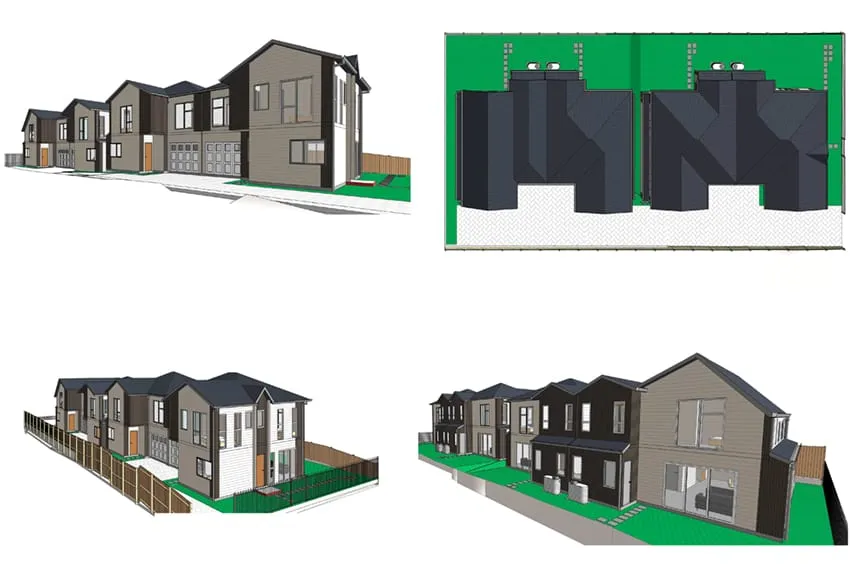


 BIM Modeling
Introduction
Outsourcing Building Information Modeling (BIM) services has shifted from a cost-saving tactic to a strategic necessity for top-tier architecture, engineering, and construction (AEC) firms. As the demand for complex, clash-free, LOD 400 models outpaces the availability of local talent, firms are turning to specialized BIM partners to scale their operations.
However, handing over critical project data to an external team naturally raises questions about quality, security, and communication. In this guide, our senior BIM consultants answer the top 25 most frequently asked questions about outsourcing BIM modeling.
Key Takeaways
Key Takeaways
General BIM Outsourcing Questions
1. What does it mean to outsource BIM services?
Outsourcing BIM involves partnering with a specialized, external virtual design and construction (VDC) company to handle tasks like 3D modeling, clash detection, family creation, or 2D drafting, rather than relying solely on in-house staff.
2. Why do architecture firms outsource BIM?
Firms outsource to manage fluctuating workloads, access specialized expertise (like complex MEP coordination), reduce overhead costs (software licenses, hardware, salaries), and accelerate project delivery times.
3. Will outsourcing replace my in-house BIM team?
No. Strategic outsourcing is designed to supplement your in-house team. Your internal staff focuses on high-level design, client management, and coordination, while the outsourced team handles the heavy lifting of mass modeling and detailing.
4. What is the difference between Offshoring, Nearshoring, and Onshoring?
- Offshoring: Partnering with a firm in a distant time zone (e.g., India, Philippines). Offers high cost-savings but requires asynchronous communication.
- Nearshoring: Partnering with a firm in a nearby time zone (e.g., Mexico, South America). Balances cost savings with real-time communication.
- Onshoring: Partnering with a domestic firm. Highest cost, but easiest communication and cultural alignment.
5. What services are most commonly outsourced?
- Revit Architecture & MEP Modeling
- Scan to BIM (Point Cloud Conversion)
- Navisworks Clash Detection
- Construction Documentation (CDs)
- Parametric Family Creation
Quality and Technical Questions
6. How do I ensure the outsourced model matches our firm’s standards?
Before modeling begins, you provide your firm’s Revit template (.rte), standard details, and drafting guidelines. The external team strictly adheres to these standards, ensuring the final deliverable looks exactly as if it were produced internally.
7. What is a BIM Execution Plan (BEP)?
A BEP is a foundational document that defines the project’s goals, the required Level of Development (LOD) for every element, software versions, file naming conventions, and coordination protocols.
8. What is LOD, and why does it matter?
Level of Development (LOD) defines the geometric and informational reliability of a BIM element. Specifying the correct LOD (e.g., LOD 300 for design, LOD 400 for fabrication) ensures you don’t overpay for unnecessary detail.
9. What software do BIM outsourcing firms use?
Top-tier firms utilize the Autodesk AEC Collection (Revit, Navisworks, Civil 3D, AutoCAD), alongside specialized tools like ArchiCAD, Bluebeam, and various point cloud processing software (e.g., ReCap).
10. How is clash detection handled remotely?
Models are federated in Navisworks. The external team runs automated clash tests, generates a clash report (often in a platform like Revizto or BIM Track), and coordinates with your internal engineers to resolve the issues sequentially.
Communication and Project Management
11. How do we communicate across different time zones?
Experienced outsourcing partners establish overlap hours for real-time meetings (via Zoom or Teams) and utilize asynchronous tracking tools (like Jira, Trello, or Asana) to manage daily tasks.
12. How do we share large Revit models securely?
The industry standard is to use a Common Data Environment (CDE) such as Autodesk BIM 360 / ACC, Procore, or secure cloud drives. This ensures a single source of truth and prevents version control issues.
13. What happens if there is an error in the model?
Reputable firms include a QA/QC (Quality Assurance/Quality Control) phase in their workflow. If an error is found that violates the BEP or provided markups, the firm corrects it at no additional cost.
14. Will I have a dedicated Project Manager?
Yes. You should always be assigned a dedicated Project Manager or BIM Coordinator who acts as your single point of contact, ensuring smooth communication and accountability.
15. Can I hire a dedicated remote modeler instead of paying per project?
Yes. Many firms, including Core BIM Solutions, offer FTE (Full-Time Equivalent) models, where you hire a dedicated Revit technician who works exclusively on your projects under your direct supervision.
Pricing and Contracts
16. How is BIM outsourcing priced?
There are three main pricing models:
- Lump Sum (Fixed Price): Best for well-defined projects with a strict scope.
- Hourly Rate: Best for dynamic projects with ongoing design changes.
- Dedicated FTE (Monthly Retainer): Best for long-term capacity building.
17. Is it cheaper to outsource than to hire in-house?
Generally, yes. When calculating the true cost of an in-house employee, you must factor in salary, benefits, office space, hardware ($3k+ workstation), and software licenses ($3k+ per year). Outsourcing eliminates these overheads.
18. How do you estimate the hours required for a project?
Estimators review your CAD files, PDFs, or point clouds, analyze the required LOD and square footage, and calculate the hours based on historical data from similar projects.
19. Do I have to sign a long-term contract?
No. Most firms allow you to start with a single, small pilot project to test their capabilities before committing to larger scopes.
20. How is intellectual property (IP) protected?
Before any files are exchanged, a strict Non-Disclosure Agreement (NDA) is signed. Your designs, families, and templates remain your exclusive property and are never shared or reused.
The Transition Process
21. How do I start outsourcing?
Start small. Identify a low-risk, non-urgent project. Prepare your Revit template, compile a clean package of input files (PDFs, CAD), and request a pilot project from the BIM provider.
22. What inputs do you need to start a 3D model?
We typically require:
- Architectural and Structural 2D CAD/PDF plans.
- Elevations and Sections.
- The required LOD specification.
- Your firm’s Revit template (.rte).
23. Can you convert our hand sketches to Revit?
Yes. As long as the sketches include accurate dimensions and clear design intent, skilled modelers can translate them into precise BIM models.
24. What if the design changes midway through the project?
Design changes are handled via Change Orders or billed hourly. It is crucial to communicate changes immediately so the modelers don’t waste time detailing an outdated layout.
25. Why should I choose Core BIM Solutions?
At Core BIM Solutions, we combine decades of enterprise-level AEC experience with a rigorous QA/QC process. We don’t just “draft”; we act as an extension of your VDC department, providing constructible, data-rich models that save money in the field.
Conclusion
Outsourcing BIM modeling is a powerful strategy to scale your firm’s capabilities, but it requires careful planning, strict standardization, and the right partner. By understanding the processes, pricing, and communication protocols, you can confidently integrate external expertise into your workflow.
Ready to test the waters? Contact Core BIM Solutions today to schedule a free consultation and launch your first pilot project.


